Why Most Software Projects Fail Before a Single Line of Code Is Written
Why Most Software Projects Fail Before a Single Line of Code Is Written
When a software project fails, the explanation almost always sounds the same. The development took too long. The budget was exceeded. Bugs kept appearing. The application was difficult to maintain, or the final product simply wasn't what the client expected.
Because these problems become visible during development, it's easy to assume that development itself is where things went wrong. The conversation quickly turns toward programming languages, development frameworks, testing practices, or the capabilities of the engineering team. Somewhere along the way, the project becomes labeled as "a failed software project."
In reality, software rarely fails because developers suddenly forget how to write code. More often, development is simply the stage where earlier mistakes become impossible to ignore.
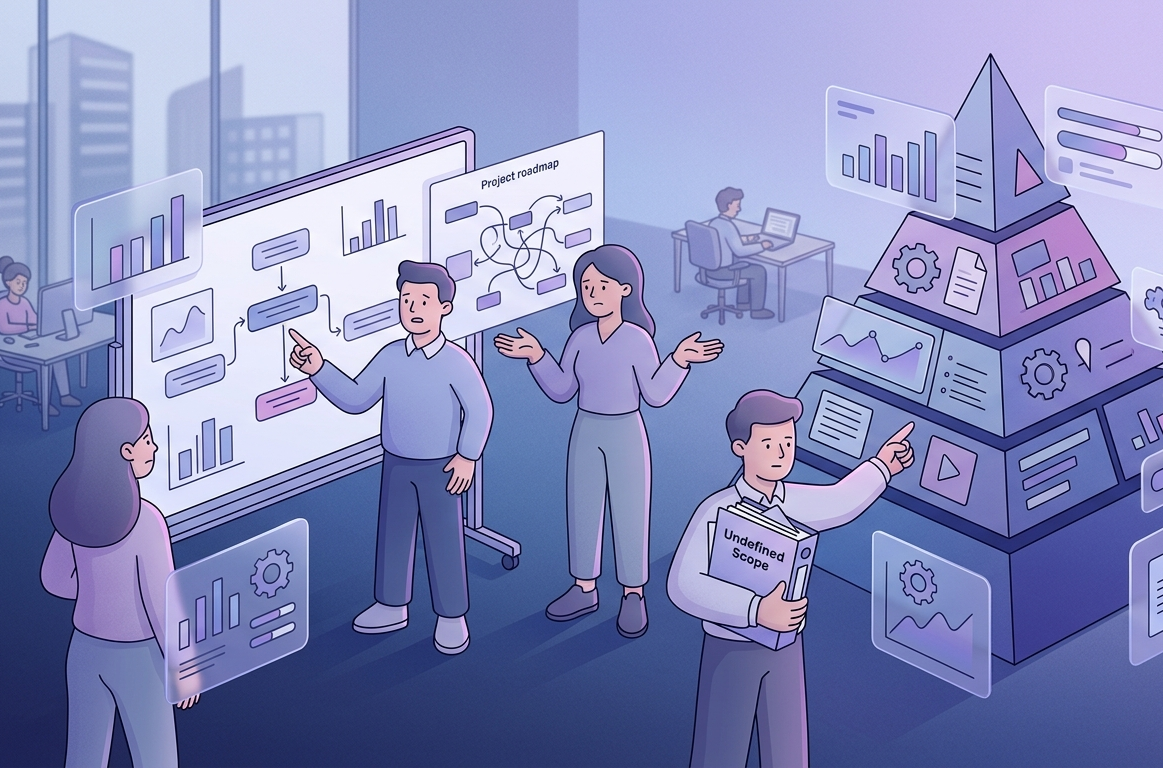
By the time the first line of code is written, many projects have already accumulated weeks or even months of unclear assumptions, undefined objectives, conflicting expectations, and unanswered questions. Development doesn't create these problems. It merely exposes them.
The uncomfortable truth is that software projects usually begin failing long before anyone opens a code editor.
Software Is Built Twice
Every successful software product is built twice.
The first version exists only as conversations, diagrams, requirements, user journeys, business objectives, and strategic decisions. During this stage, nothing has been programmed, yet nearly every important decision about the project's future is already being made. Teams decide what problem they're solving, who they're solving it for, how success will be measured, and which trade-offs they're willing to accept.
Only after these questions are answered does the second version begin; the version developers transform into working software.
Many organizations unintentionally reverse this order. They become excited about building and rush directly into development, believing that unanswered questions can be resolved along the way. At first, this feels productive. Screens begin taking shape, databases are designed, and features gradually appear.
Eventually, however, reality catches up.
A feature behaves differently than stakeholders imagined. Departments disagree on business rules that were never documented. Users interact with the application in unexpected ways. New requirements emerge because the original ones were too vague to begin with.
What appears to be changing requirements is often something much simpler.
The requirements were never truly understood.
Unclear Goals Create Perfectly Built Failures
One of the greatest misconceptions in software development is that building exactly what was requested guarantees success. It doesn't.
A team can deliver every requested feature, meet every deadline, stay within budget, and still produce software that creates very little value. This happens because software doesn't exist to satisfy a list of requirements. It exists to solve a business problem. Those are not the same thing.
Imagine a company asking for a dashboard containing twenty different performance metrics. Developers faithfully implement every chart, every filter, and every visualization. The dashboard functions flawlessly. Yet months after launch, employees continue making decisions exactly as they did before because the dashboard never answered the questions they actually needed answered.
Technically, the software succeeded. From a business perspective, it failed. The difference lies in understanding goals rather than requests. Requirements describe what people think they want. Goals explain why they want it.
Without understanding the second, building the first becomes little more than an expensive guessing exercise.
Requirements Are Conversations, Not Documents
Many people imagine software requirements as lengthy specification documents filled with technical details and flowcharts. While documentation is undoubtedly important, requirements themselves are far more dynamic than the documents that eventually describe them.
Good requirements emerge through conversation.
They evolve as teams ask better questions, challenge assumptions, and uncover hidden complexities that initially seemed obvious. Every answer tends to reveal another question. What appears to be a simple approval process suddenly involves multiple departments. A straightforward reporting feature uncovers inconsistencies in the underlying data. A seemingly universal workflow turns out to vary significantly between different teams.
These discoveries are not signs of failure. They are evidence that the project is becoming better understood before expensive development begins. Skipping this stage doesn't eliminate complexity, it merely postpones it until making changes becomes dramatically more expensive.
The Most Expensive Bugs Aren't Technical
When developers hear the word "bug," they naturally think of broken functionality or unexpected system behavior. From a business perspective, however, the most expensive bugs are often conceptual rather than technical.
Building the wrong feature is a bug.
Automating an inefficient process is a bug.
Creating software that encourages poor workflows is a bug.
Designing an interface around incorrect assumptions about users is a bug.
Unlike programming errors, these problems cannot be fixed by changing a few lines of code. They often require redesigning significant portions of the product because the underlying understanding was flawed from the beginning.
The "later" these conceptual mistakes are discovered, the more "expensive" they become.
This is why experienced software teams spend so much time asking questions that initially seem unrelated to programming. They are not delaying development. They are protecting it.
Planning Creates Speed, Not Delay
One reason organizations rush into development is the fear that planning slows projects down. When stakeholders are eager to see visible progress, weeks spent discussing workflows or refining requirements can feel unproductive compared to watching new features appear every few days.
The psychology is understandable. Humans naturally associate visible activity with meaningful progress. A working interface feels more tangible than a whiteboard full of diagrams. Yet software doesn't reward speed at the beginning nearly as much as it rewards clarity.
Every hour invested in understanding users, defining objectives, mapping workflows, and validating assumptions reduces uncertainty for the hundreds of development hours that follow. Developers spend less time rewriting features. Designers make more confident decisions. Stakeholders request fewer last-minute changes because expectations were aligned from the start.
Planning doesn't delay development. Poor planning delays delivery. The distinction becomes obvious only after the project is underway.
Great Software Begins With Understanding People
It is easy to think of software as a technical product because technology is the medium through which it is built. In reality, software is fundamentally about people.
Every application exists because someone is trying to accomplish something more effectively. A customer wants to purchase faster. A manager wants clearer insights. A healthcare professional wants better access to patient information. An operations team wants fewer repetitive tasks.
Code simply becomes the mechanism that enables those outcomes.
When teams become overly focused on technology, they risk optimizing the wrong thing. They debate frameworks instead of workflows, performance benchmarks instead of user experience, and technical elegance instead of practical usefulness.
The most successful software projects reverse that perspective. They begin by deeply understanding the people who will ultimately use the system, the problems those people encounter every day, and the decisions the software should help them make. Only then does technology become meaningful.
Building Software Is Really About Reducing Uncertainty
Every software project starts with uncertainty.
- Will users adopt the product?
- Will the workflow scale?
- Will this feature solve the intended problem?
- Will the investment generate measurable value?
The purpose of discovery, planning, prototyping, and requirements gathering is not to eliminate uncertainty completely, that is impossible. Their purpose is to reduce uncertainty enough that development becomes a confident investment rather than an expensive experiment.
The organizations that consistently deliver successful software understand this principle. They don't begin by asking, "How quickly can we start coding?"
They begin by asking, "What do we still not understand?"
That single question changes the trajectory of an entire project.
Final Thoughts
Software projects rarely fail because developers lack technical expertise. More often, they struggle because development begins before the business problem has been fully understood. When goals remain unclear, requirements become unstable. When requirements are unstable, development becomes unpredictable, leading to changing priorities, missed expectations, and costly rework.
Successful software isn't defined by how quickly it is built but by how effectively it solves the problem it was created to address. That requires clarity before coding, thoughtful planning before implementation, and a shared understanding of what success actually looks like. By investing time in discovery and strategy at the beginning of a project, organizations create a stronger foundation for every design decision, feature, and line of code that follows.
The best software projects don't start with programming. They start with understanding.
Build Software on the Right Foundation
Every successful software product begins with a clear understanding of the business behind it. Before writing code, it's important to define objectives, validate requirements, and design workflows that solve real problems, not just implement requested features.
At DevStudio, we believe software development starts long before development itself. Our discovery process focuses on understanding your business, your users, and the challenges you're trying to solve so that every technical decision supports a meaningful business outcome.
Whether you're building a new product, modernizing internal systems, or replacing outdated software, DevStudio helps transform ideas into scalable, well-planned solutions with clarity from day one.
Learn how DevStudio can help you plan, design, and build software that delivers lasting business value.