Build vs Buy - When Custom Software Is Actually Worth It
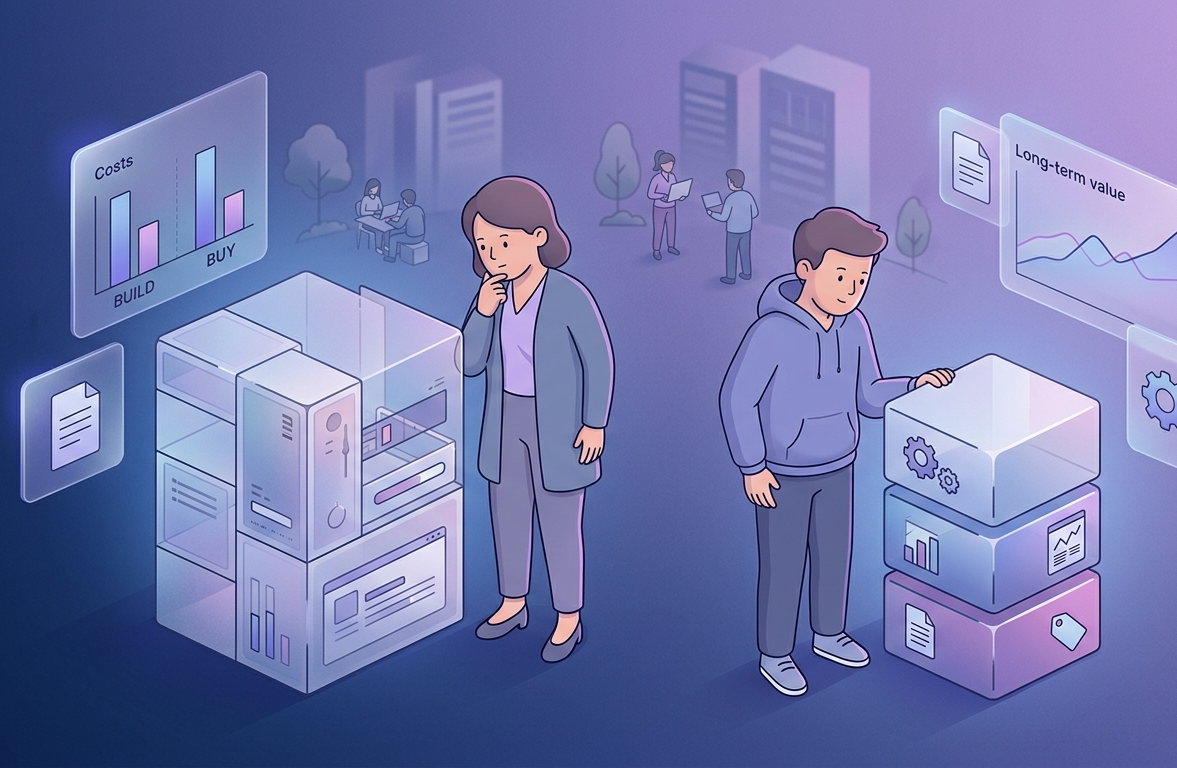
Build vs Buy: When Custom Software Is Actually Worth It
One of the first decisions businesses face when improving their operations isn't what software to build, it's whether they should build anything at all.
Today's market offers thousands of software products for almost every imaginable business function. Customer relationship management, accounting, inventory, human resources, project management, analytics, and communication are all supported by mature platforms that can be deployed within days. From the outside, creating custom software can seem unnecessary when so many ready-made solutions already exist.
That assumption is often correct.
Not every business needs custom software, and building software simply because it is possible is rarely a good investment. In many cases, purchasing an existing solution is faster, less expensive, and significantly less risky than developing one from scratch. The challenge is knowing when that advice no longer applies.
There comes a point where businesses begin adapting themselves to fit their software instead of expecting software to support the way they operate. Processes become increasingly constrained by the limitations of generic platforms. Teams develop workarounds, duplicate information across multiple systems, and rely on spreadsheets to bridge gaps that should never have existed in the first place.
At that stage, the question is no longer whether software is needed. The question becomes whether the business has outgrown the software it depends on.
Software Is a Tool, Not a Goal
When organizations discuss technology, the conversation often becomes centered around products. Teams compare features, pricing plans, integrations, and user interfaces, hoping to identify the "best" software available.
Yet software itself is rarely the objective. The real objective is improving the way a business operates.
Whether that means serving customers faster, reducing manual work, increasing visibility, or enabling better decision-making, software is simply the mechanism through which those outcomes are achieved. Losing sight of this distinction often leads businesses to evaluate software based on capabilities rather than usefulness.
A platform may advertise hundreds of features, but if a company consistently uses only a handful of them while struggling with one missing capability that defines its workflow, the feature count becomes irrelevant.
Choosing software should never begin with asking, "Which platform is the most powerful?"
It should begin with asking, "What problem are we actually trying to solve?"
Buying Software Solves Common Problems Exceptionally Well
Off-the-shelf software exists because many business challenges are remarkably similar across industries.
Most organizations need to manage invoices, communicate internally, track sales opportunities, or organize projects. These are mature problems with mature solutions, refined over years through feedback from thousands of customers.
For businesses whose processes closely resemble industry standards, buying software is often the smartest decision. Implementation is faster, maintenance is handled by the vendor, security updates arrive automatically, and the total cost of ownership is usually far lower than building and maintaining an equivalent system internally.
Buying also allows businesses to focus their energy where it matters most. Instead of investing months developing functionality that already exists elsewhere, teams can dedicate their resources to serving customers, improving operations, and growing the business.
Custom software should never replace good commercial software simply for the sake of uniqueness.
If an existing solution genuinely meets your needs, it is often the better investment.
The Hidden Cost of Making Generic Software Fit Unique Businesses
Problems begin to emerge when businesses become fundamentally different from the assumptions built into commercial software.
Every software product is designed around a particular model of how work should happen. For most companies, those assumptions are perfectly reasonable. For others, they introduce constant friction.
Perhaps approvals involve multiple departments that standard workflows cannot accommodate. Maybe operational data must move between systems that were never designed to communicate. Perhaps employees spend hours each week exporting spreadsheets simply to reconcile information from different platforms.
Individually, these inconveniences may seem insignificant. Collectively, they become part of everyday work.
Employees gradually accept repetitive manual tasks as unavoidable. Managers spend valuable time coordinating disconnected systems instead of making decisions. Small inefficiencies compound across hundreds of employees and thousands of working hours until they quietly become one of the organization's largest operational costs.
Ironically, many businesses continue paying subscription fees for software while simultaneously paying employees to work around that software's limitations.
Custom Software Creates Value When Your Process Creates Value
One of the strongest indicators that custom software may be worthwhile is when the way your business operates provides a genuine competitive advantage.
Imagine a logistics company whose scheduling process consistently reduces delivery times compared to competitors. Or a healthcare provider with a highly specialized patient workflow developed through years of practical experience. Or a manufacturer whose production planning significantly improves efficiency.
These processes are valuable because they differentiate the business.
Attempting to force them into generic software often requires compromising the very advantages that make the organization successful.
Custom software allows technology to adapt to the business rather than requiring the business to adapt to the technology. Instead of replacing unique processes with standardized ones, it strengthens them, automates them, and makes them scalable.
In these situations, software stops being an operational expense. It becomes a strategic asset.
Sometimes the Best Answer Is Both
The build-versus-buy conversation is often presented as though businesses must choose one approach exclusively.
In reality, many successful organizations do neither. They combine both.
Standard software continues handling common business functions where differentiation offers little value. Accounting platforms manage finances. Email services handle communication. CRM systems organize customer interactions.
Custom software is then developed only where it creates measurable business value.
Rather than replacing every existing platform, custom systems integrate with them, filling the gaps that commercial software cannot address. This approach allows businesses to benefit from the reliability of mature products while investing development resources only where they generate meaningful returns.
It is often the most practical balance between cost, flexibility, and long-term scalability.
Think Beyond Today's Requirements
A software decision should never be evaluated solely on today's needs.
Businesses evolve. Teams grow, processes mature, customer expectations change, and entirely new opportunities emerge over time. A solution that works perfectly for twenty employees may become increasingly restrictive once the company expands to two hundred.
This does not automatically justify building custom software today. It does, however, highlight the importance of understanding where the business intends to be several years from now.
Technology decisions influence far more than immediate productivity. They shape future flexibility. Choosing software is ultimately choosing the environment within which the business will continue evolving.
The best decision is rarely the cheapest one today. It is the one that creates the fewest obstacles tomorrow.
There Is No Universal Right Answer
Businesses often search for simple rules.
Always build.
Always buy.
Never reinvent the wheel.
While these phrases are memorable, they overlook the complexity of real organizations.
The right decision depends on far more than budget alone. It depends on the uniqueness of your operations, the strategic importance of your processes, the maturity of existing software, your long-term objectives, and the value technology creates within your organization.
For one company, purchasing an existing platform may unlock years of growth. For another, building tailored software may remove limitations that have quietly constrained the business for years.
Neither approach is inherently better. The value lies in choosing intentionally.
Final Thoughts
The question isn't whether custom software is superior to commercial software.
The question is whether your business gains enough value from custom software to justify building it.
If standard solutions already support your operations effectively, buying is often the smartest decision. But when your competitive advantage depends on workflows, processes, or experiences that existing platforms cannot accommodate, custom software becomes more than a technical investment. It becomes an investment in the way your business creates value.
There is no universal answer to the build-versus-buy decision. The right choice depends on understanding your business, identifying where technology creates real value, and choosing a solution that supports both your current needs and future growth.
The goal is not to build more software. The goal is to build the right solution for the problems that matter most.
Need Help Evaluating Your Software Strategy?
At DevStudio, we don't believe every business needs custom software. Sometimes the best solution is adopting an existing platform. Other times, custom development is the right investment to remove limitations and unlock new opportunities.
Our role is to help businesses understand the difference.
If you're deciding between building, buying, or combining both approaches, we can help you evaluate your options and identify the solution that creates the greatest long-term value for your organization.